

Best Control & Relay Panel (CRP) Manufacturer in India for Substation Automation System (SAS)
Key Takeaways
- Voltech, an ISO certified manufacturer, builds Control & Relay Panels from 33kV up to 400kV — the substation control panel, relay panel and protection panel in one — engineered for integration with modern Substation Automation Systems (SAS).
- Built around IEC 61850 GOOSE and MMS messaging, replacing point-to-point copper wiring with a station bus.
- Numerical multi-function relays and bay control units combine protection, control and metering in one device.
- Demand is rising fastest in solar, wind, green hydrogen, BESS and data centers, where Voltech has already commissioned its first C&R Panel + SAS Automation order for a grid-scale BESS project.
Why hardwired panels can't keep pace with a digital grid — and how Voltech's CRP panels with integrated SAS automation deliver IEC 61850 protection and control for substations, renewables and BESS.
Introduction — The Control Room Inside Every Bay
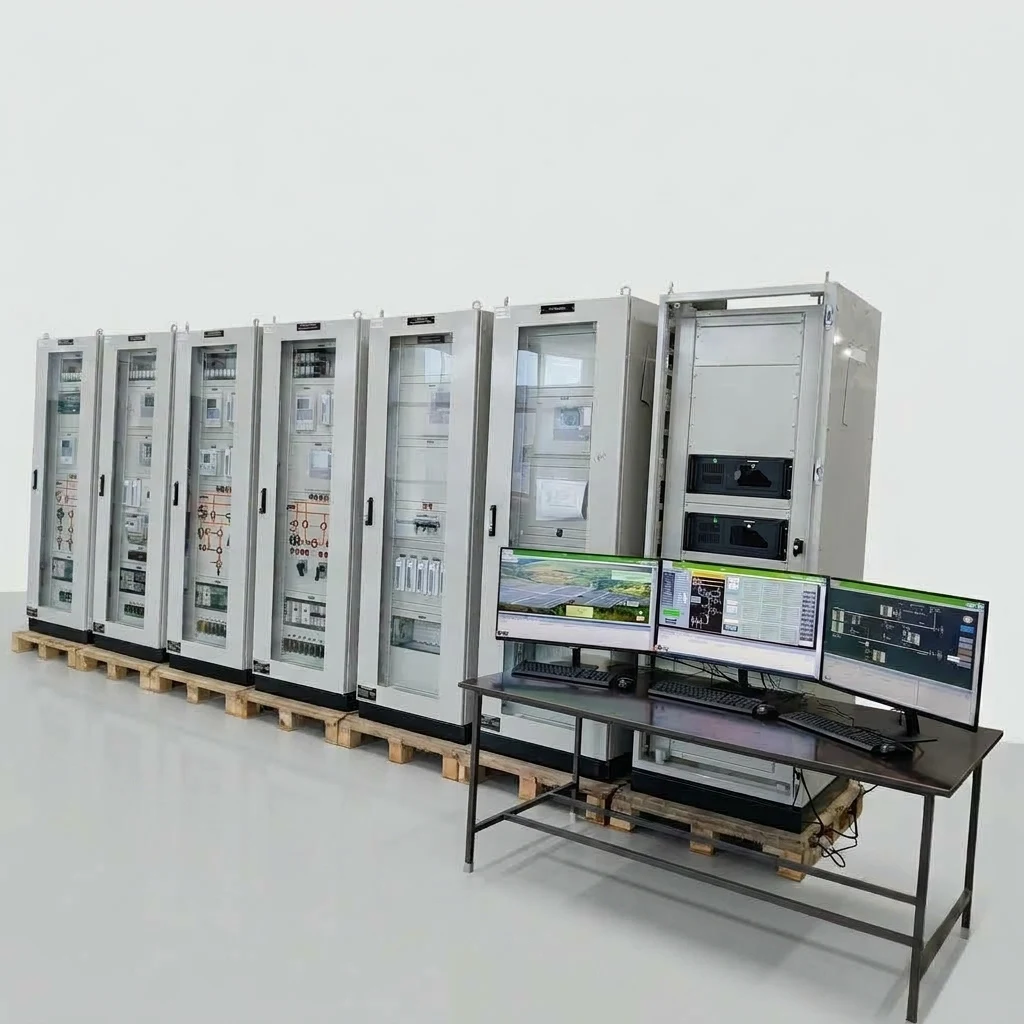
Every breaker trip, every fault isolation, every MW that reaches or leaves the grid passes through one piece of equipment that decides how fast and how safely it happens: the Control & Relay Panel. Today that means a digital bay unit talking IEC 61850 to a station-wide automation platform.
A control panel in a substation is the cabinet that lets operators control breakers and isolators, while the relay panel in the substation detects faults and trips them. In practice both functions sit together in the CRP panel, and rows of them are housed in the CRP room in the substation — the control room at the heart of every outdoor substation and switchyard.
A C&R panel houses the protection relays, meters, control switches and annunciation for one or more bays of a substation — feeders, transformers, bus couplers, incomers. Voltech, an ISO certified company with in-house manufacturing of Control & Relay Panels up to 400kV, builds these substation relay panels and substation control panels for integration with a SAS: numerical relays and bay controllers communicate over an Ethernet station bus using the IEC 61850 standard, feeding a SAS server/HMI and an RTU/gateway that talks on to the control centre SCADA or a renewable/BESS energy management system.
Advantages of Substation Automation System
The same CRP panel in a substation now covers feeder, line and transformer protection panel duties, controls each VCB in the substation from one bay unit, and reports every operation to SCADA.
| Parameter | Conventional Hardwired Panel | Digital SAS-Integrated Panel (Voltech) |
|---|---|---|
| Signal wiring | Point-to-point copper per signal | IEC 61850 GOOSE over Ethernet station bus |
| Protection | Electromechanical/static relays | Numerical multi-function relays, IEC 61850 compliant |
| Monitoring | Local meters and annunciators only | Real-time SAS server/HMI, remote SCADA visibility |
| Event history | None, or basic local logging | Sequence-of-events (SOE), fault & disturbance recording |
| Renewable/BESS integration | Custom hardwired interface per plant | Native protocol-level link to plant SCADA/EMS/PCS |
The IEC 61850 Standard
IEC 61850 is the international standard that lets numerical relays, bay controllers and the station-level SAS server exchange data over a common Ethernet network instead of dedicated copper. GOOSE messaging carries trips and interlocks bay-to-bay in milliseconds, while MMS carries monitoring and control data up to the SAS server/HMI and on to SCADA — the architecture shown below.
Why Legacy C&R Panels Fail in Modern Grid & Renewable Environments
- Wiring bottleneck at scale: Every added feeder or bay in a hardwired scheme means new copper runs and re-testing. A GOOSE-based station bus adds a bay by configuration, not by re-cabling the CRP room in the substation.
- No visibility until it's too late: Electromechanical schemes give no sequence-of-events trail after a trip. A SAS platform with fault and disturbance recording tells maintenance teams exactly what happened, in what order, within milliseconds.
- Limited protection depth for high voltage: A basic high voltage control panel with static relays cannot match the multi-function numerical protection a modern substation protection panel provides at 33kV, 132kV and above.
- Renewable and BESS plants move faster than a hardwired panel can follow: Solar and wind SCADA, and BESS energy management systems, expect protocol-level data — not a rack of auxiliary relays translating contacts into signals.
Engineered Control & Relay Panels for Reliable Substation Protection, Monitoring and Control
Specification of Voltech's Control & Relay Panel with integrated SAS, engineered for substations, data centers, renewable plants and BESS sites.
| Parameter | Specification | Application Relevance |
|---|---|---|
| Panel Rating | 33kV control relay panel up to 400kV high voltage control panel | Scales from distribution bays to grid substations |
| Panel Types | Feeder, line, transformer protection panel, bus coupler, incomer | Covers each bay of the substation relay panel line-up |
| Protection Relays | Numerical, multi-function (O/C, E/F, differential, distance) | Single device covers protection, control and metering |
| Automation Protocol | IEC 61850-8-1 (GOOSE), MMS; Sampled Values optional | Standardized bay-to-station communication |
| SCADA/Gateway Protocols | IEC 60870-5-101/104, DNP3, MODBUS RS-485/TCP | Interfaces with control-centre SCADA and plant EMS |
| Network Architecture | Redundant Ethernet ring / dual-homed | No single point of failure on the station bus |
| Event Recording | Sequence-of-events (SOE), fault & disturbance records | Complete diagnostic trail after every operation |
| Bay Control | Local/remote select-before-operate, interlocking logic, VCB control | Safe switching of the VCB in substation with standardized interlock checks |
| Installation | CRP panel in substation, indoor CRP room line-up | Suited to outdoor substations and renewable plant switchyards |
| Renewable/BESS Interface | Protocol-level link to plant SCADA, BMS/PCS/EMS | Native integration for solar, wind and BESS sites |
| Testing | In-house FAT/SAT, IEC 61850 conformance testing | Panel and automation validated together before dispatch |
India's Grid Modernization & Renewable Backbone
- The global substation automation market stood at USD 40.04 billion in 2026, projected to reach USD 57.59 billion by 2031 at a 7.54% CAGR, with Asia-Pacific — led by India and China — the fastest-growing region at roughly 9.7% CAGR.
- India's switchgear market — the hardware layer every C&R panel sits alongside — is valued at USD 5.78 billion in 2026, growing to USD 8.24 billion by 2031 (7.35% CAGR), backed by an estimated INR 9.1 trillion (~USD 109 billion) in transmission capex through FY32 and a mandate for 250 million smart meters under the Revamped Distribution Sector Scheme.
- India's Battery Energy Storage System (BESS) market is the fastest-moving segment of all — from USD 2.05 billion in 2026 to USD 8.59 billion by 2031, a 33.2% CAGR, directly pulling demand for C&R panels with SAS/EMS integration at every new storage site.
Sector Deep-Dive: Solar, Wind & Green Hydrogen
India's renewable build-out is the largest structural driver of C&R panel and SAS demand nationwide. Solar targets 293 GW by 2030 against roughly 119 GW in 2025; wind targets 100 GW by 2030 against roughly 50 GW today; and the National Green Hydrogen Mission targets 5 million tonnes/year by 2030, backed by an estimated 125 GW of associated renewable capacity — all part of India's overall 500 GW non-fossil capacity target by 2030.
Sector Deep-Dive: Battery Energy Storage Systems (BESS)
India's BESS market is projected to grow from USD 2.05 billion in 2026 to USD 8.59 billion by 2031, a 33.2% CAGR — the fastest of any segment feeding C&R panel and SAS demand. Every grid-scale BESS site needs a control and protection layer that talks to the battery management system (BMS) and power conversion system (PCS) as fluently as it talks to the grid — the role Voltech's first C&R Panel + SAS order for a BESS project was built for.
Sector Deep-Dive: Data Centers
India's operational data center capacity reached 1,789 MW in H1 2026, up from around 400 MW in 2019, with 3,860 MW of new capacity expected by 2030 and about USD 29.9 billion of development capital required (Cushman & Wakefield). A data center cannot tolerate a protection failure, so the dedicated substations feeding it need CRP panels with fast numerical protection, a redundant IEC 61850 station bus and SAS monitoring that flags faults before they become outages. Read how Voltech's SAS-automated control and relay panels address data center reliability.
Control & Relay Panels for African Substation and Renewable Projects
Africa added about 4.5 GW of solar in 2025, a 54% jump on 2024 (Global Solar Council), while its installed renewable capacity reached 82,397 MW, up nearly 16% (IRENA). Every one of those plants and the substations that connect them needs protection, control and SAS integration.
- Nigeria — Control & Relay Panels for Nigerian EPC Projects: about 803 MW of solar added in 2025, Africa's second-largest market.
- Kenya — Protection & Control Panels for Kenyan Substation Projects: roughly 551 MW of installed solar feeding a fast-expanding national grid.
- Ghana — Relay Protection Solutions for Ghana Power Projects: 92 MW of solar added in 2025, with a target of 520 MW by 2030.
- Morocco — Substation Protection & Control Solutions Morocco: 4,851 MW of renewables, 39.6% of installed capacity, the highest share in North Africa.
Voltech also supplies CRP panels and substation protection and control solutions across Algeria, Burkina Faso, Gabon, Cameroon, Ivory Coast (Côte d'Ivoire), Mali, Senegal, Tanzania, Togo and Uganda, with the same IEC 61850 SAS integration and 33kV to 400kV range.
Frequently Asked Questions
What is a CRP, and what is a C&R panel?
Control & Relay Panel is abbreviated as CRP and is also called a C&R panel.
What is a CRP room in substation and what is CRP in substation?
CRP in substation means the line-up of control and relay panels, and the CRP room is the substation control room housing them for every feeder, transformer and line bay, with the SAS server and HMI alongside.
What is the difference between a control panel in substation and a relay panel in substation?
The control panel operates breakers and isolators; the relay panel senses faults and trips them. A CRP panel combines both. This differs from PLC, drive or MCC panels, which control process motors and loads rather than protect the grid.
What does a transformer protection panel do?
It uses differential, overcurrent and earth fault relays to isolate a faulty transformer quickly. Along with feeder and line panels, it forms the substation protection panel line-up.
How does the C&R panel control a VCB in a substation?
The bay unit issues open/close commands to the vacuum circuit breaker (VCB), checks interlocks first, and trips it on relay operation, with status reported to the SAS.
Do you offer CRP panels for African substation and EPC projects?
Yes — our Control & Relay Panels with IEC 61850 SAS integration are offered for substation, solar, wind and BESS projects across Algeria, Burkina Faso, Cameroon, Gabon, Ghana, Ivory Coast, Kenya, Mali, Morocco, Nigeria, Senegal, Tanzania, Togo and Uganda.
What does SAS automation add to a C&R panel?
SAS puts an IEC 61850 digital communication layer on top — numerical relays exchange GOOSE messages over a station bus, feeding a SAS server/HMI and gateway, instead of relying purely on hardwired copper.
Can a C&R panel with SAS integrate with solar, wind or BESS control systems?
Yes — the automation layer talks natively to plant SCADA, and to a BESS's BMS/PCS/EMS, over standard protocols such as IEC 61850, IEC 60870-5-104, DNP3 or MODBUS.
What voltage classes does Voltech's C&R panel cover?
Voltech manufactures Control & Relay Panels in-house from the 33kV control relay panel up to 400kV, scaling from distribution feeders to grid-level and outdoor substations.

Start Your Technical Consultation
To initiate a technical consultation for your Control & Relay Panel and SAS Automation requirements, reach out to our team.
[email protected]