

Key Takeaways
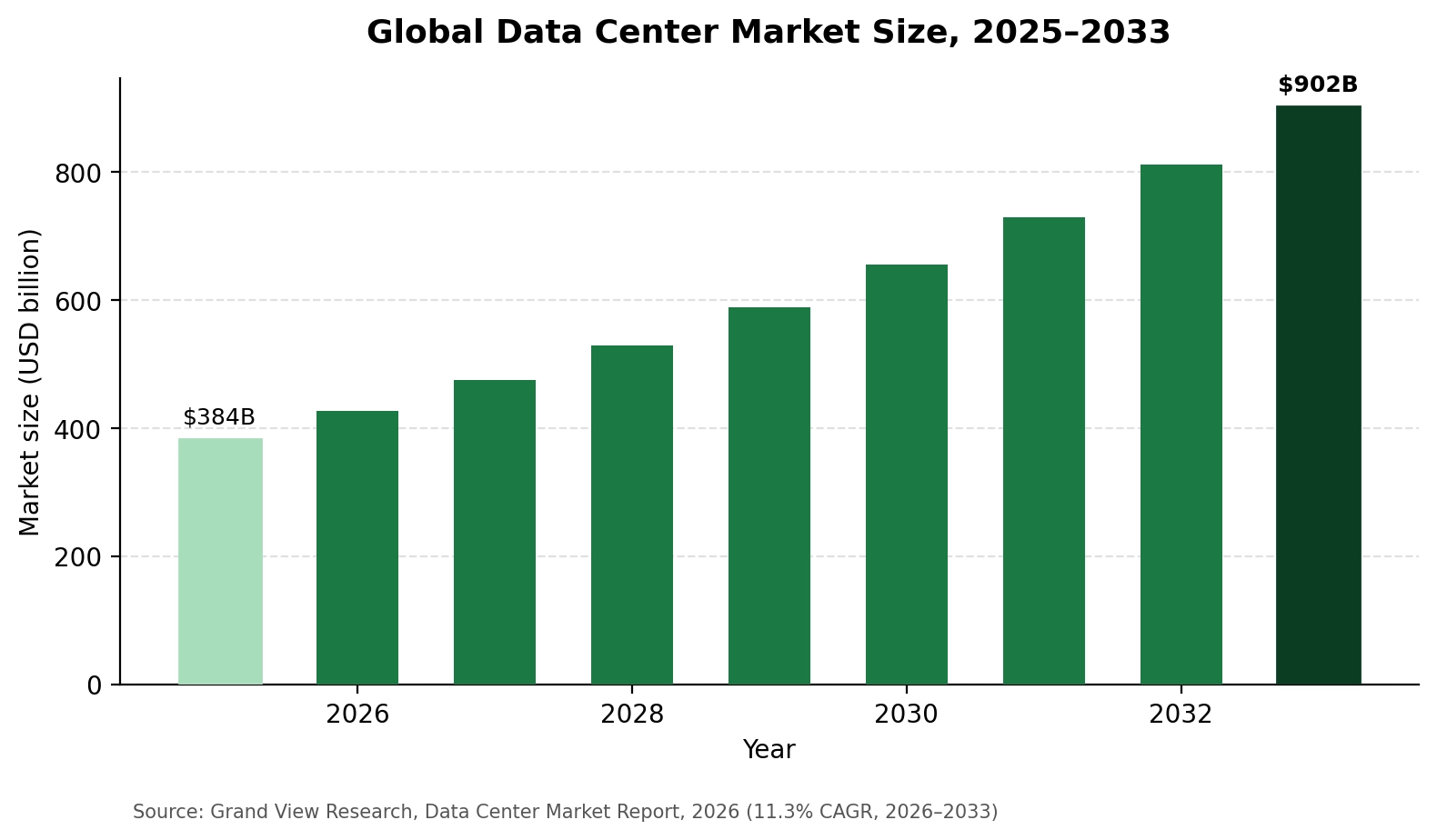
- Market growth: the global data center market will grow from roughly $380 billion in 2025 to $900 billion-plus by 2033, an 11.3% CAGR.
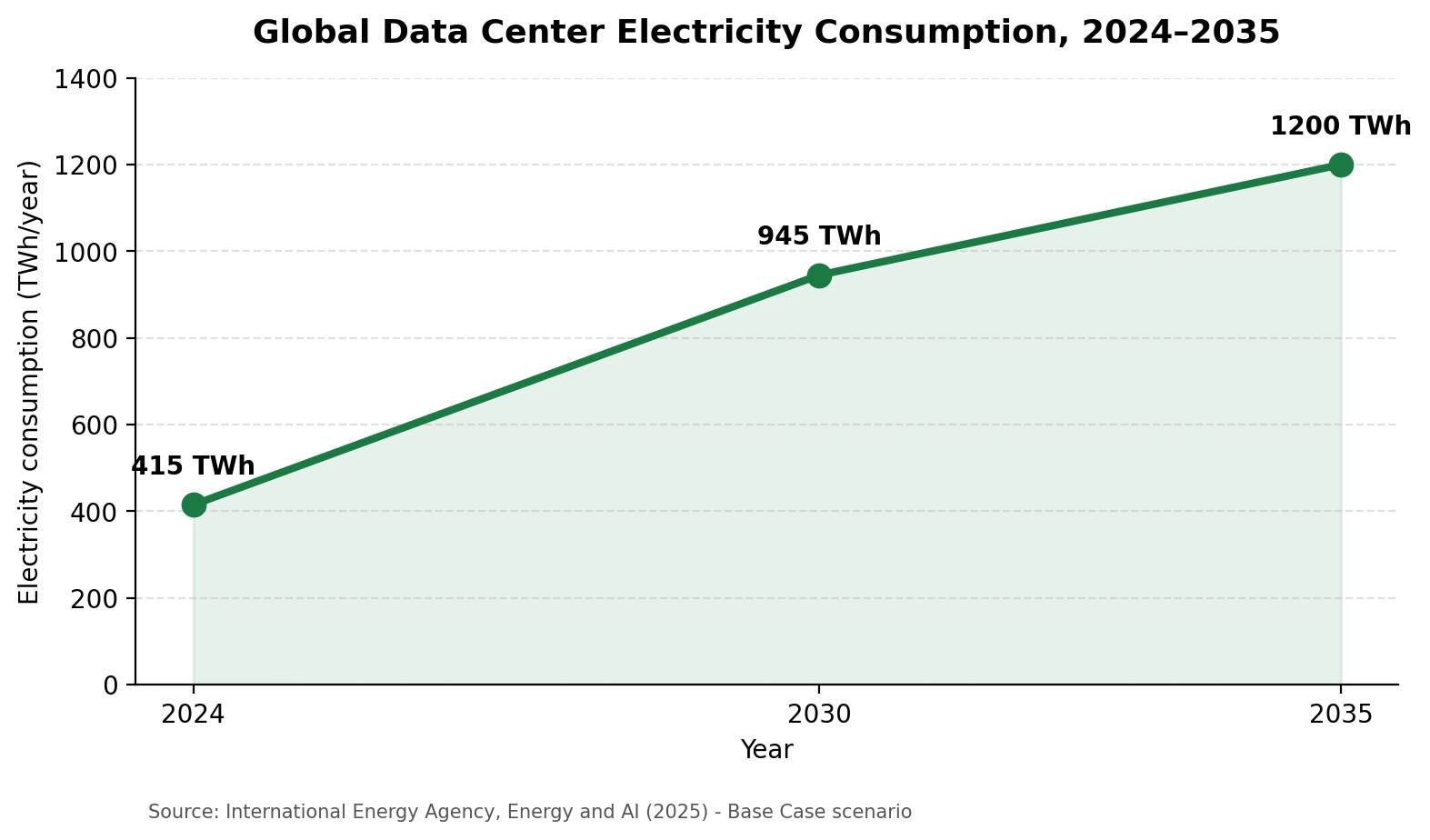
- Power demand: global data center electricity consumption will more than double, from 415 TWh in 2024 to 945 TWh by 2030 (IEA).
- Primary risk: power failures, mostly UPS and battery-related, cause roughly 45% of serious data center outages (Uptime Institute).
- Voltech's solution: SAS-automated, IEC 61850-aligned control and relay panels coordinating protection across the utility feed, generator, and UPS.
- Proof point: Voltech panels are deployed at an NXTRA (Bharti Airtel) data center in Chennai, India.
Every cloud query, UPI payment, and AI prompt resolves to a server rack, and that rack lives or dies by the power feeding it.
Here's what the data tells us.
Turning the page on the data center industry
The data center industry sits quietly behind almost every digital transaction on earth, yet it is now one of the fastest-growing pieces of physical infrastructure in the world economy. Global data center capacity is closing in on 100 gigawatts, roughly double the installed base of a decade ago, and the sector's electricity demand has grown at roughly 12 percent a year over the last five years, a pace the International Energy Agency expects to continue as AI workloads scale. Colocation and hyperscale facilities are absorbing the bulk of new capital, and India is one of the fastest-expanding regions, with capacity expected to roughly double from 3.3 GW in 2025 to 6.7 GW by 2030.
This is an industry defined by a single, unforgiving constraint: it cannot go dark. That constraint is what makes the electrical backbone, the switchgear, batteries, relays, and control panels most people never see, the real center of gravity of the industry.
Data center industry footprint
As AI, cloud computing, and digital transformation drive demand, the sector now represents a market of roughly $380–400 billion, projected to grow to between $625 billion and $900 billion-plus by the early 2030s at a CAGR of 9–11 percent. Hardware, including servers, switchgear, UPS systems, cooling, and electrical infrastructure, accounts for more than two-thirds of this spend.
The energy footprint tells the sharper story. Data centers consumed about 415 TWh of electricity in 2024, projected to more than double to around 945 TWh by 2030. Data centers already account for 4.4 percent of U.S. national power consumption, a share some forecasts see rising to 12 percent by 2028, meaning the equipment sitting between the grid and the data hall will carry nearly triple today's load within four years.
Data center industry interdependence: grid, telecom, and supply chain risk
The data center industry is highly interdependent, relying simultaneously on the electricity grid, the telecom backbone, real estate and construction, semiconductor supply chains, and the renewable energy market. A disruption in any one of these can stall a facility's uptime target: a grid brownout in one region, a delayed transformer shipment from another, or a chip shortage on the other side of the world can each independently stall a project timeline.
This interdependence runs in both directions. Data centers are expected to drive nearly half of all electricity demand growth in the United States through 2030. At the same time, the IEA warns that around one in five planned data center projects could face delays due to grid connection queues, since new transmission lines can take four to eight years to build and wait times for transformers and cables have doubled in the past three years.
Inside the facility, that interdependence gets tighter still. The utility feed, standby generators, UPS batteries, and the control and relay panels that coordinate them all have to act as a single, synchronized system, because a failure in any one link cascades instantly into an IT-facing outage.
Four core challenges facing the data center industry
The data center industry faces four central challenges: power reliability, grid and energy constraints, sustainability pressure, and a shortage of skilled operations staff. Each is driven by AI-scale ambitions colliding with hard physical constraints, and each points toward the same path forward: automation engineered into the electrical backbone itself.
Power reliability
Power reliability is the industry's weakest link: power issues account for roughly 45 percent of serious and severe outages, most often traced back to UPS and battery-related failures. More than half of operators surveyed by the Uptime Institute say their most recent significant outage cost over $100,000, and one in five say it cost more than $1 million. Four in five believe the incident could have been prevented with better management and monitoring, which points squarely at the control and protection layer.
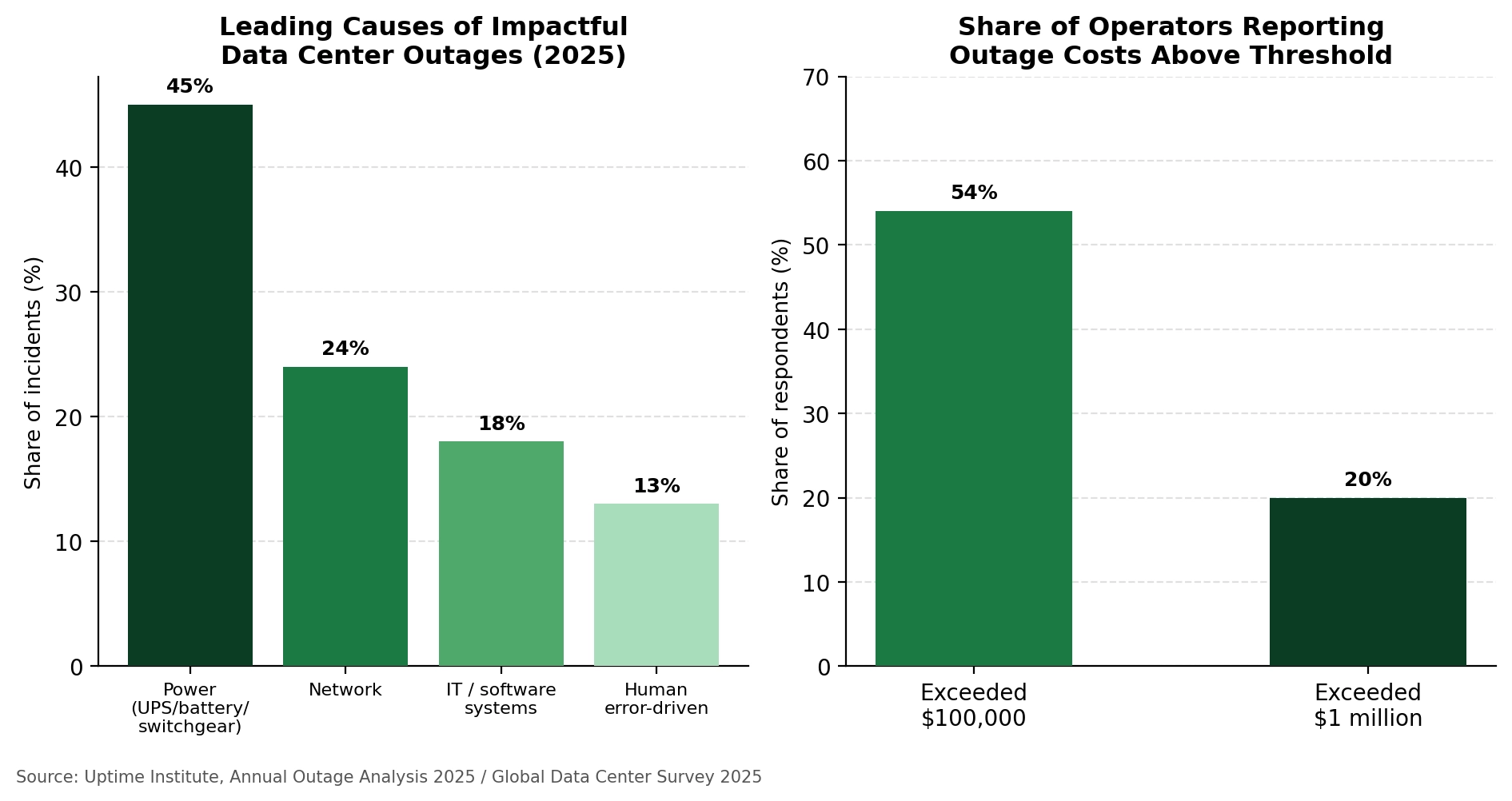
Because UPS, battery, and switchgear failures alone cause 45 percent of serious outages (Fig. 3), this is the specific failure mode Voltech's SAS-automated control and relay panels are designed to intercept.
Grid and energy constraints
Grid and energy constraints refer to the growing mismatch between data center demand and available utility capacity. Rising rack densities and AI workloads are straining both the grid and backup systems, so those systems have to be smarter, faster, and better monitored than before.
Sustainability and efficiency pressure
Sustainability and efficiency pressure is the demand on operators to cut energy waste even as consumption rises. With demand set to double this decade, operators face pressure to run more efficient infrastructure and reduce wasted energy in standby systems.
Skills and human error
Skills and human error refers to the operational risk created when staff lack the training or discipline to prevent avoidable outages. Uptime Institute research finds a large share of outages trace back to staff failing to follow procedure. Automation and remote monitoring reduce dependence on manual intervention at exactly the moments human error is most likely.
The path forward runs through the same theme every time: automation, visibility, and resilience have to be engineered into the electrical backbone itself, rather than bolted on after a facility is built.
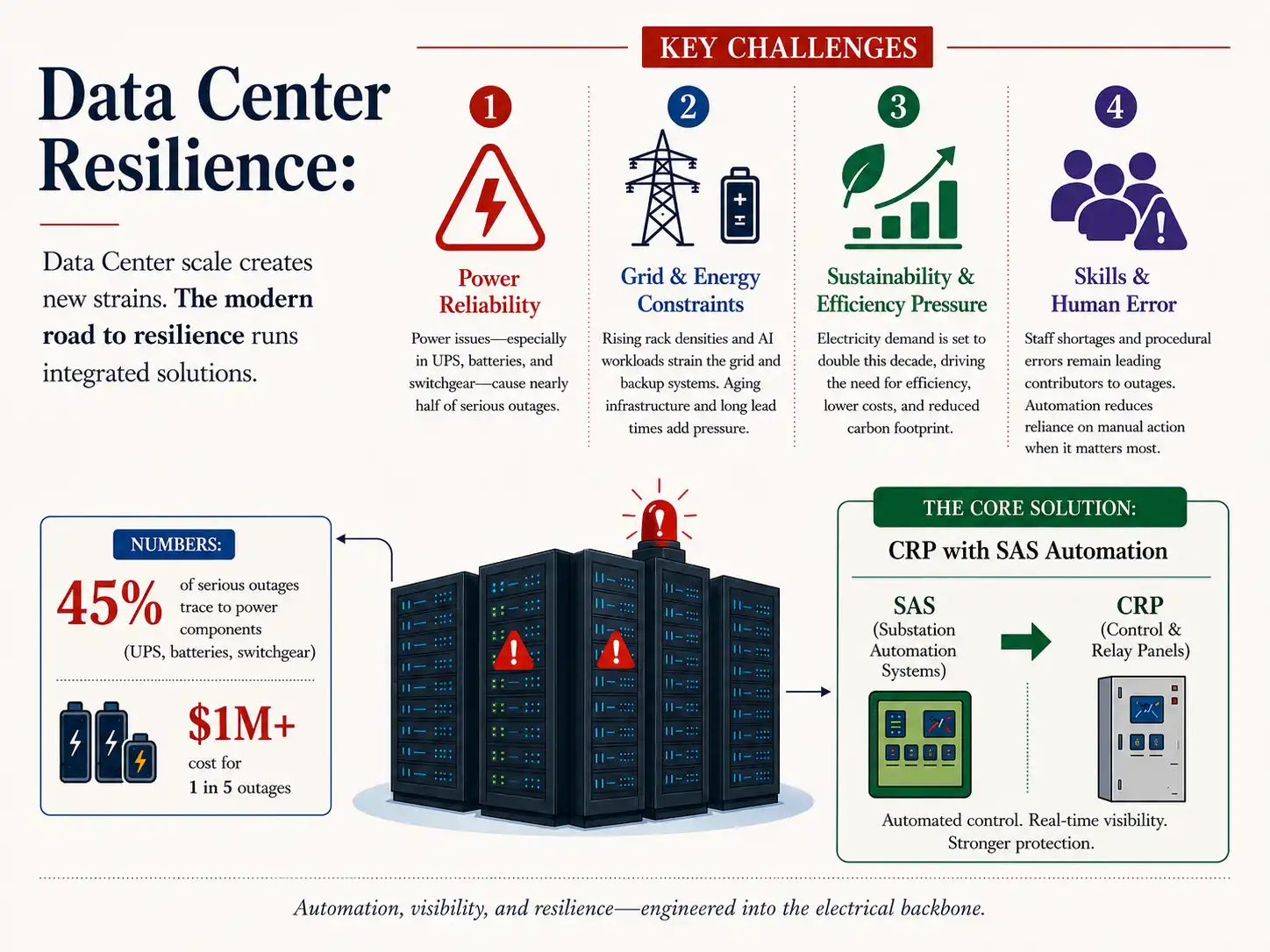
The 45 percent and $1M+ figures above are general industry reference points from Uptime Institute's outage research, not specific to any one project. Separately, on the solution side, Voltech's own SAS-to-CRP approach is already delivering that same automated coordination in production at the NXTRA Chennai facility, detailed below.
NXTRA data center, Chennai
Voltech has supplied control and relay panels to an NXTRA (Bharti Airtel) data center in Chennai, one of India's fastest-growing colocation and hyperscale hubs, where Nxtra operates facilities with a combined IT power capacity of over 45 MW. The panels provide SAS-based coordination between incoming utility feeds, DG backup, and UPS/battery systems, giving the operations team synchronized protection and a single point of visibility across the electrical yard.
NXTRA is one entry in a much broader track record. Across India, Voltech's electrical, testing, commissioning, and facility management teams have now served more than 373 MW of data center capacity across 18 facilities in 10-plus locations.
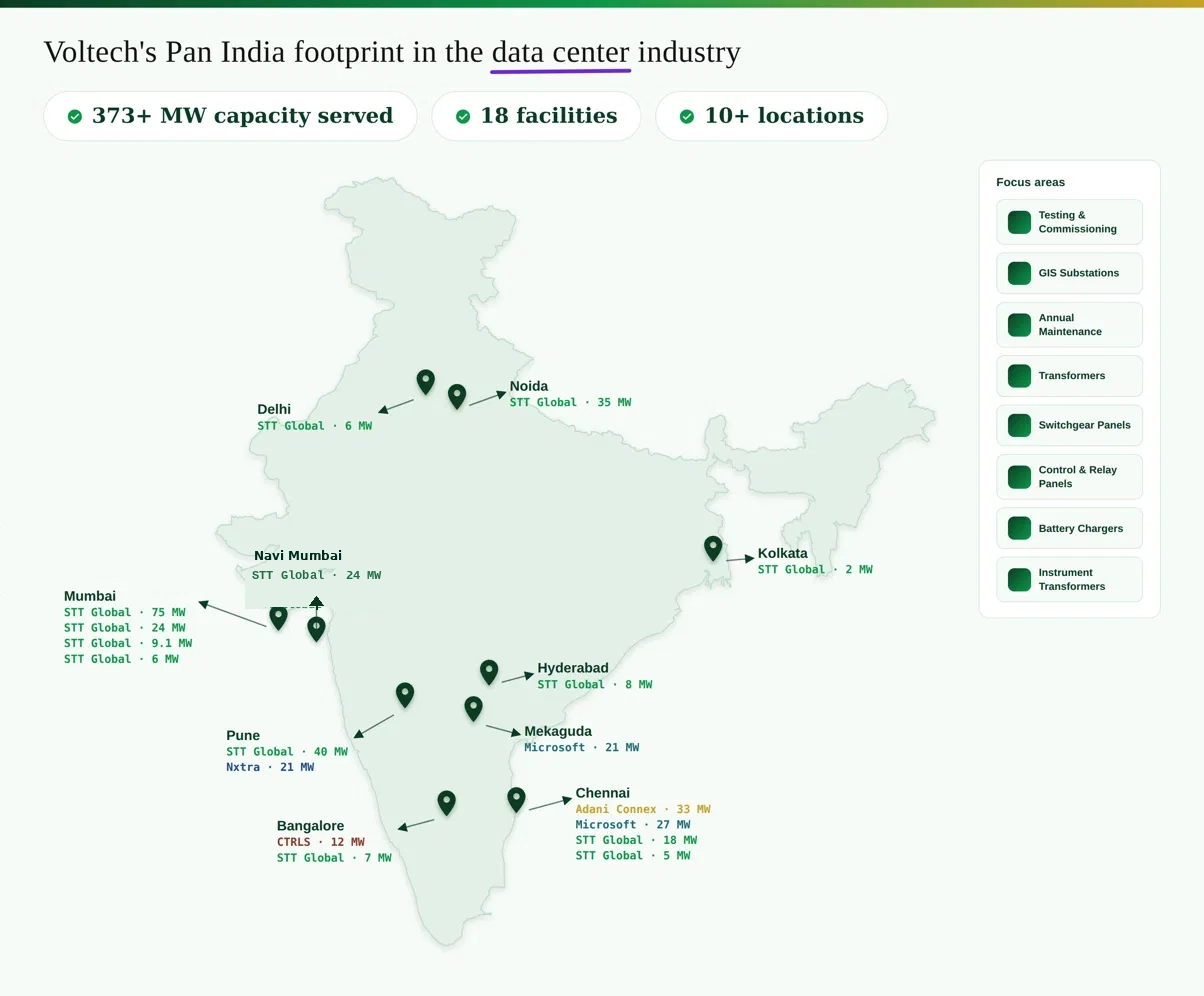
This footprint spans the country's principal data center hubs. In Mumbai and Navi Mumbai, Voltech has delivered testing, commissioning, and switchgear work across four STT Global facilities totaling more than 114 MW, the largest concentration in the portfolio. The Delhi-NCR cluster adds STT Global capacity in Delhi and Noida, with Kolkata rounding out eastern India. South India is especially deep: Chennai carries engagements with Adani Connex, Microsoft, and STT Global; Bangalore spans CTRLS and STT Global; and the Hyderabad-Mekaguda corridor includes STT Global and Microsoft. Pune adds further scale with STT Global and Nxtra.
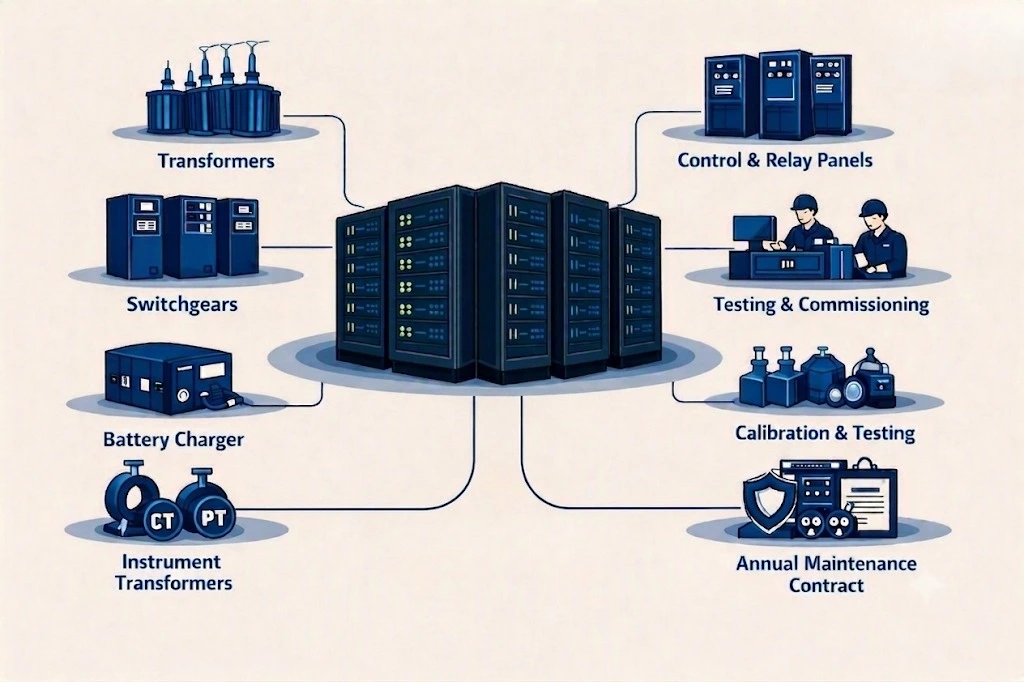
Across every site, Voltech's scope of work is consistent and includes:
- Testing and commissioning
- GIS substations
- Switchgear panels
- Control and relay panels
- Power & Distribution Transformers
- Battery chargers
- Instrument transformers
- Annual Maintenance Contracts
- Transformer Servicing
This consistent scope gives hyperscale operators and colocation and telecom players a single, dependable partner for India data center electrical infrastructure.
International data center projects
Voltech's data center footprint extends beyond India into the Gulf, spanning five hyperscale and government engagements across Bahrain and Oman, primarily 11kV and 12kV switchgear testing, commissioning, and troubleshooting, delivered with regional partners including Shaksy Electromech, Danway Electrical Mechanical Engineering, and Mideast Data System.
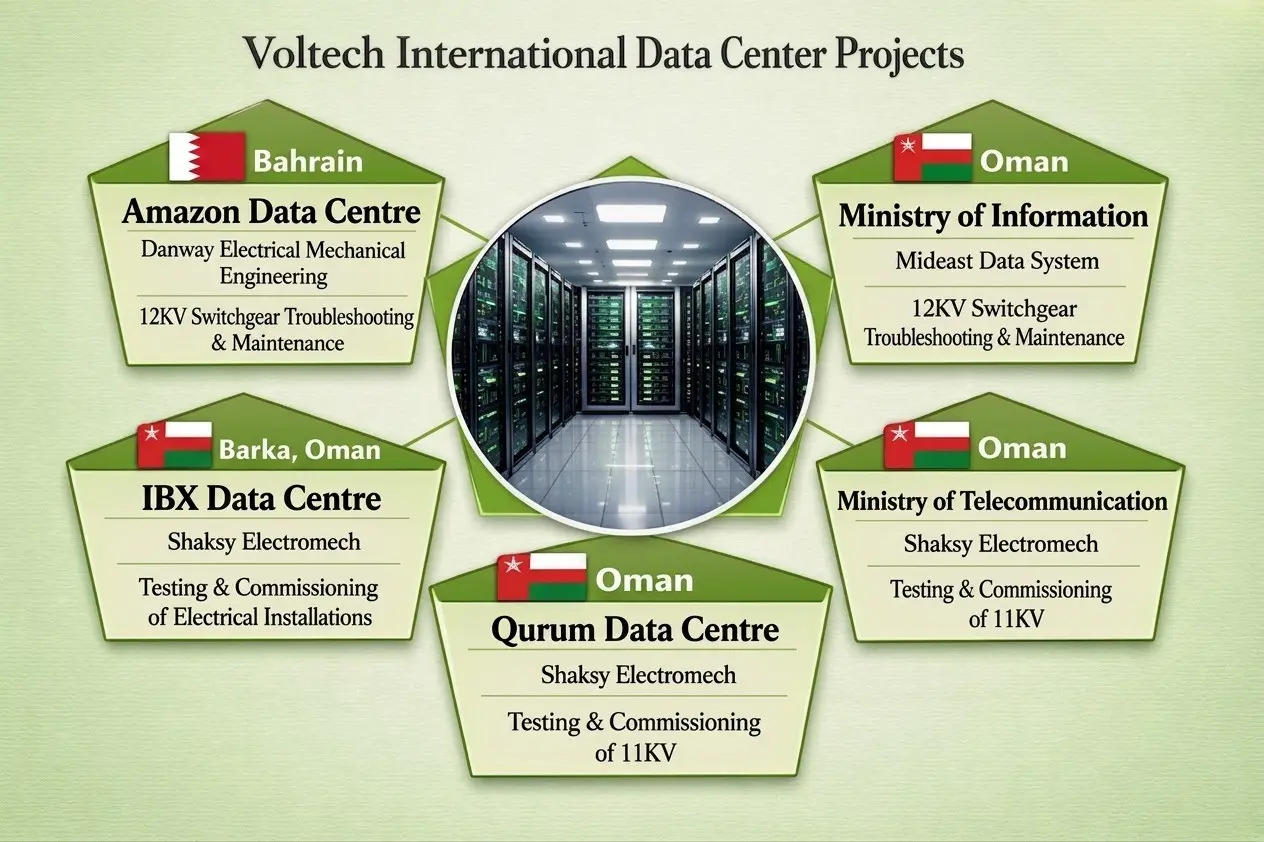
In Bahrain, Voltech supported the Amazon Data Centre through Danway Electrical Mechanical Engineering, delivering 12kV switchgear troubleshooting and maintenance. Across Oman, the portfolio broadens further: 12kV switchgear work for the Ministry of Information's Mideast Data System, 11kV testing and commissioning for the Ministry of Telecommunication and the Qurum Data Centre with Shaksy Electromech, and full electrical installation testing and commissioning at the IBX Data Centre in Barka.

Start Your Technical Consultation
To initiate a technical consultation for your data center electrical requirements, reach out to our team.
[email protected]