

Fiji Desalination Plant Power Challenges and Solutions
Fiji is heading into the final months of 2026 with power rationing on the table. Infrastructure Minister Ro Filipe Tuisawau has warned that El Niño dryness could force rationing if hydropower reservoirs keep falling (Xinhua), while unplanned outage hours across Viti Levu have risen every year since 2023, with the first half of 2026 already above each of those full years (Fiji Times; a sum of individual outages, not whole-system downtime). In Vuna, Taveuni, villagers say their desalination plant is out of operation (Fijivillage).
Desalination plants need steady power exactly when hydro is under stress and communities need water most. Here is what that means for Fiji's water security, and how proven electrical engineering solutions can help.
Key Takeaways: Fiji's Power and Water Risks in October 2026
- Rationing risk: Energy Fiji Limited (EFL) is conserving water at Monasavu Dam, Fiji's largest hydro scheme, and increasing thermal generation. The dam stood at 732.2 m on 28 September, 17.2 m above its safe operating level, with El Niño conditions threatening below-average rainfall into early 2027 (FBC News).
- Demand growth: EFL serves about 230,000 customers, with annual demand of 1,100 GWh growing about 5% a year and limited reserve margins (Fiji Sun).
- Little grid headroom: in January 2026, EFL warned the grid was operating close to capacity, with blackout risk rising whenever a major generation or transmission asset is unavailable (Fiji Sun).
- Storm exposure: Tropical Cyclone Vaianu damaged the 132 kV Wailoa–Cunningham line in April 2026, triggering an island-wide outage on Viti Levu and temporary rationing in the Central Division (Fiji Times).
- Water access gaps: more than 4,200 residents in southern Taveuni have lacked reliable water for over a decade (Lowy Institute).
Table 1. Fiji's power and water risks at a glance
What Is Desalination Infrastructure, and Why Does Power Reliability Matter?
Desalination infrastructure is the chain of intake, pretreatment, reverse osmosis, pumping, energy recovery, storage and electrical systems that turns seawater or brackish water into drinking water. In Fiji, seawater reverse osmosis (SWRO) and brackish water reverse osmosis (BWRO) plants depend on an uninterrupted supply to high-pressure pumps. That makes grid reliability, transformers, switchgear, protection relays and SCADA as important to water security as the membranes themselves.
Why Desalination Matters for Fiji's Water Supply
Fiji is an archipelago of more than 300 islands, roughly a third of them inhabited. Many depend on rainwater, boreholes or surface sources that strain during dry spells. Climate variability, saltwater intrusion into coastal groundwater, cyclone-driven flooding and rising demand from tourism and urban growth raise the stakes every year.
Desalination offers a climate-independent source of drinking water. Resorts across the Mamanuca and Yasawa islands, outer island communities in Lau, Kadavu and Taveuni, and the growing Suva–Nausori and Nadi–Lautoka corridors all make the case for seawater and brackish water reverse osmosis as part of a resilient Fiji water supply mix.
Six Electrical Challenges in Fiji's Power Sector That Put Desalination Plants at Risk
Fiji's electricity sector is investing in transmission, distribution and renewables. Energy Fiji Limited (EFL), the principal utility, lists transmission expansion, grid reliability, renewable energy development and climate resilience among its infrastructure priorities. Each of these shapes the power supply that desalination plants depend on.
1. Grid reliability and distribution network upgrades
As demand grows and new generation connects, reliability depends on network capacity, equipment condition, fault detection and protection coordination. A voltage dip or unplanned trip stops high-pressure RO pumps and forces a restart cycle that wears equipment and cuts output.
2. High-voltage transmission and substation expansion
EFL's programme includes new 132 kV lines, switching stations and substations, with work associated with Virara, Koronubu, Rarawai and Tavua (EFL 2024 Annual Report). Plants near these networks need switchgear, high capacity power transformers and protection selected for system voltage and fault levels.
3. Transformer, protection and automation requirements
Power and distribution transformers, Control and Relay Panels with CRP automations, substation panels, numerical relays and SCADA all need correct specification, protection relay testing and commissioning before energisation. Without them, faults go unseen and operators lack visibility across control panel substations and dispersed assets.
4. Renewable integration and battery storage
EFL has documented grid-connected solar in Viti Levu and a solar PV and battery installation at Mua, Taveuni (EFL renewable projects). Connecting inverter-based generation demands transformer capacity, protection coordination and voltage management to protect power quality.
5. Cyclone, flood and coastal exposure
Cyclones, heavy rain, humidity and salt-laden air attack outdoor substations, enclosures and connections. Desalination plants sit on the coast, so corrosion-resistant materials, sealed enclosures, reliable earthing and surge protection matter.
6. Outer-island and remote power distribution
Remote islands rely on grid extensions, solar, hybrid generation or storage, while shipping and maintenance access slow repairs. Equipment reliability matters most where technicians and spares are days away.
Left unaddressed, these issues raise the cost of every cubic metre of water, shorten asset life and put Fiji water security at risk.
| Challenge | Risk to the desalination plant | What it calls for |
|---|---|---|
| Grid reliability | Voltage dips and trips stop high-pressure RO pumps | Fault detection and protection coordination |
| 132 kV transmission and substations | Equipment mismatched to system voltage and fault levels | Correctly rated switchgear, transformers and protection |
| Protection and automation | Faults go unseen across dispersed assets | Specification, relay testing and commissioning before energisation |
| Renewables and battery storage | Power-quality issues from inverter-based generation | Transformer capacity, protection coordination, voltage management |
| Cyclone and coastal exposure | Corrosion and storm damage to outdoor equipment | Corrosion-resistant materials, sealed enclosures, earthing, surge protection |
| Outer-island distribution | Slow repairs where spares are days away | Equipment reliability |
Voltech's Water Infrastructure Solutions for Fiji's Desalination Plants
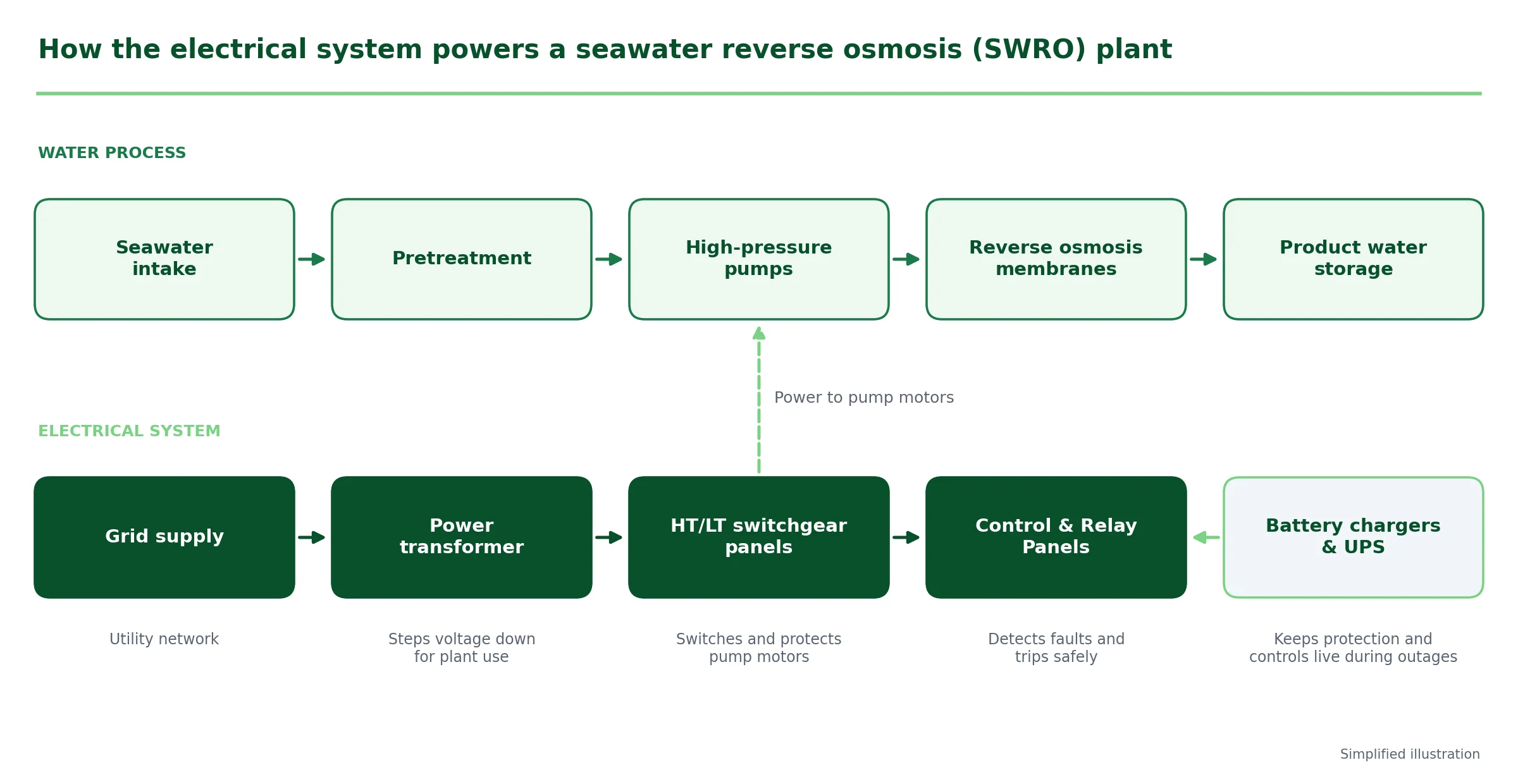
As Fiji expands desalination and water treatment capacity, it needs partners with a proven record in water infrastructure. Voltech Group's experience covers seawater desalination, water treatment plants, bulk water supply schemes, lift irrigation and island water systems, delivered for public utilities and leading EPC contractors in India and Tanzania.
Table 3. Voltech's water infrastructure credentials
Trusted by Water Authorities and Leading EPC Contractors
Voltech's public-sector clients include Chennai Metro Water, TWAD Board Tamil Nadu, UP Jal Nigam, MP Jal Nigam Maryadit, MP Water Resources, the Government of Madhya Pradesh, PHED Rajasthan, Odisha Lift Irrigation Corporation, the Governments of Odisha and Goa, Punjab Water Supply, Guwahati Jal Board, BDA and JWIL Water Management.
As one of India's relay control panel manufacturers and potential transformer manufacturers, Voltech works with major EPC contractors including L&T, JWIL, Kalpataru Water, MEIL, GVPR, NCC, SPML, Shapoorji Pallonji, Afcons and WAPCOS. Voltech holds supply performance certificates from MEIL and L&T, and purchase order credentials from L&T, Afcons, WAPCOS, JWIL and NCC.
Government Empanelments and Approvals
Voltech's water-sector equipment carries approvals from four Indian state governments:
- Rajasthan: RWSSMB and PHED, Jaipur, have approved Voltech for power transformers up to 20 MVA and distribution transformers up to 2.5 MVA.
- Odisha: RWSS, Bhubaneswar, has approved its power and distribution transformers, VCB breakers, MCVCB and panels.
- Assam: Guwahati Jal Board (GMDWSB) has approved its transformers, UPS systems, battery chargers and panels, made through Voltech's ISO certified electronics manufacturing.
- Punjab: DWSS Abohar has approved its transformers under a quality assurance plan for the Patrewala WTP Project.
Water Infrastructure Projects Delivered
In India, Voltech's projects with L&T include the Athikadavu–Avinashi Project for WRD Tamil Nadu, the Indira Sagar Project for NVDA Madhya Pradesh, the Surface Water Supply Project at Fazilka in Punjab, and nine project clusters under Odisha's Mega Lift Irrigation Scheme.
With MEIL, Voltech has supplied the Bhubaneswar Bulk Water Supply Scheme for OWSSB, four Mega Lift Irrigation project packages in Odisha, and RWSS water supply projects across six districts of Odisha. Its other domestic projects include Mega Lift Irrigation projects in Malkangiri and a further Odisha cluster with GVPR Engineers, a 30 MLD sewage treatment plant for NMCG and UP Jal Nigam with Shapoorji Pallonji, and the 150 MLD Nemmeli SWRO desalination plant for CMWSSB with JWIL Infra.
International Water Supply Projects: Tanzania
Voltech's international water-sector experience is concentrated in Tanzania. The four projects show how Voltech's products perform in coastal and island water networks like Fiji's.
Zanzibar is an archipelago in the Indian Ocean, where the Zanzibar Water Authority is rehabilitating its water supply system. Voltech supplied products to this programme through three separate EPC contractors: Afcons Infrastructure, MEIL and L&T Constructions. Selection by three contractors on one island network reflects equipment that holds up where every component arrives by sea.
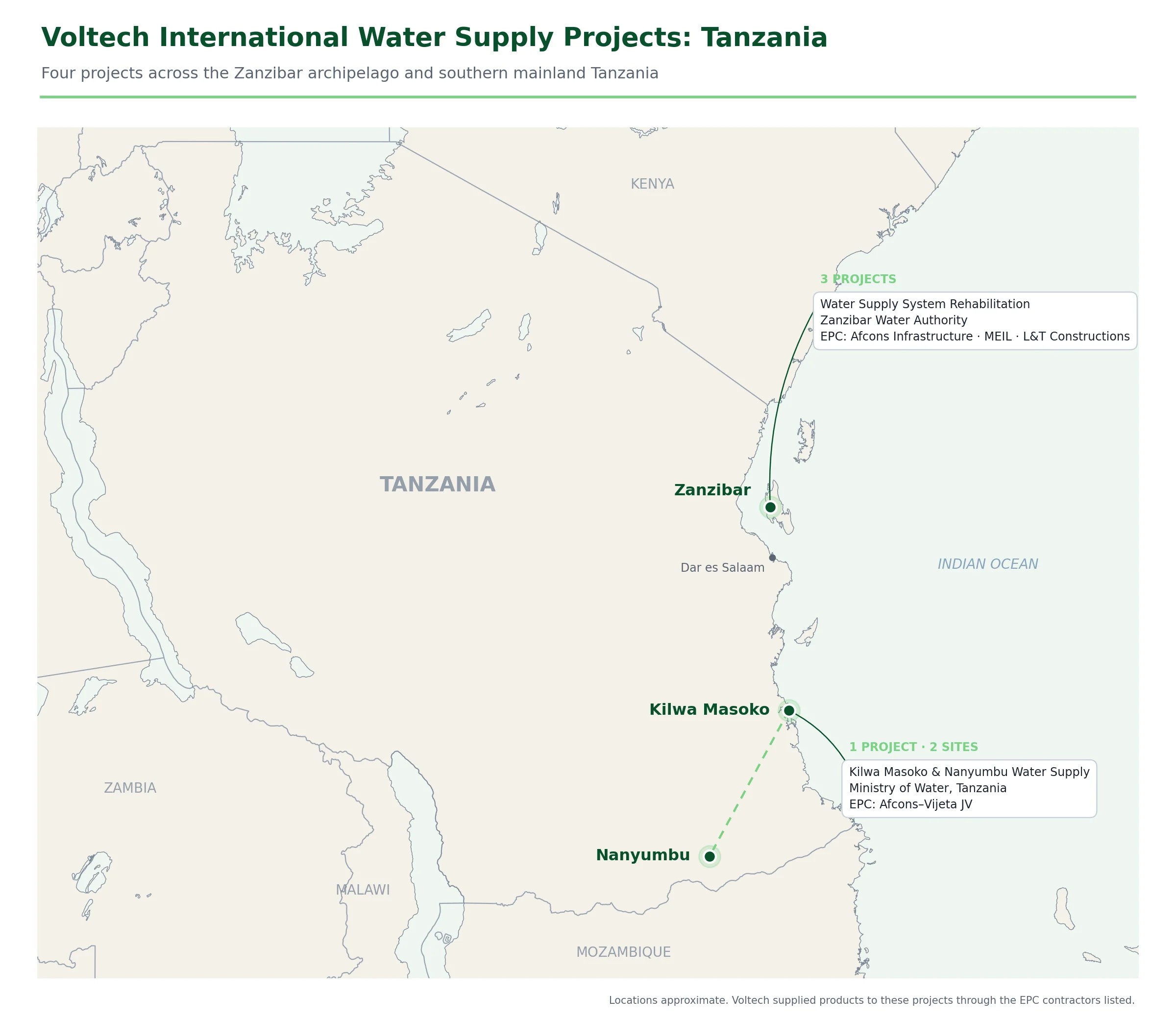
On the mainland, Voltech supplied the Kilwa Masoko and Nanyumbu Water Supply project for Tanzania's Ministry of Water through the Afcons–Vijeta JV. Kilwa Masoko is a coastal town in Lindi Region, while Nanyumbu lies inland in Mtwara Region near the Mozambique border, so a single scheme spans both shoreline and remote inland sites.
Frequently Asked Questions
Does Voltech work with EPC contractors on water projects?
Voltech has worked with major EPC contractors on their water projects, including L&T, MEIL, Afcons, Shapoorji Pallonji, GVPR Engineers, JWIL Infra, Kalpataru Water, NCC, SPML and WAPCOS.
Does Voltech hold performance certificates for its water projects?
Yes. Voltech holds supply performance certificates from MEIL and L&T, and purchase order credentials from L&T, Afcons, WAPCOS, JWIL and NCC.
Do turnkey contractors and sub-contractors source equipment from Voltech?
Yes. Turnkey contractors and sub-contractors source Voltech products such as commercial power transformers, high capacity power transformers, VCB breakers, MCVCB, substation panels, UPS systems and battery chargers.
Has Voltech worked with water utilities?
Yes. Voltech's public-sector clients include Chennai Metro Water (CMWSSB), TWAD Board Tamil Nadu, UP Jal Nigam, PHED Rajasthan and Guwahati Jal Board, alongside state governments in Odisha, Goa and Madhya Pradesh.
Has Voltech supplied products for desalination plants?
Yes. Voltech supplied products for the 150 MLD SWRO desalination plant at Nemmeli, Chennai, delivered by JWIL Infra for CMWSSB.
Has Voltech supplied products for Fiji?
Voltech has supplied products for four water supply projects in Tanzania, including the Zanzibar Water Authority's island water network. That island experience is directly relevant to Fiji, where utility operators, resorts, EPC contractors and turnkey contractors are planning desalination plants, water treatment plants and water supply upgrades across Viti Levu, Vanua Levu and Fiji's outer islands.

Start Your Technical Consultation
To initiate a technical consultation for the electrical requirements of your desalination plant or water project, reach out to our team.
[email protected]