

Best Dual Mode Battery Charger Manufacturer in India
Key Takeaways
- Voltech (VMCPL), an ISO certified manufacturer, has launched a Dual Mode FCBC rated up to 220V and 200A, compatible with all popular battery chemistries.
- Built around a fully controlled 6-pulse SCR full-wave rectifier, holding output stability against AC fluctuations at full load.
- Soft start neutralizes inrush current; overvoltage fold-back, short circuit and overload protection keep battery and load safe.
- Separate current limiting per path, plus automatic/manual Float-Boost switching with timer precision, gives independent control over load and battery recovery.
- A smart HMI logs up to 250 events or more, with single-phase preventer, EMI/EMC compliance and native PLC/SCADA/MODBUS integration.
Why standard chargers fail under grid disturbance — and how Voltech's dual mode FCBC handles SCR rectification, dual current limiting and 24x7 HMI supervision.
Introduction — The Quiet Backbone of Every Critical DC Load
Behind every relay panel, telecom BTS site and emergency shutdown system sits a piece of equipment that rarely gets attention until it fails: the battery charger. When AC supply dips, sags or vanishes, it's the Float Cum Boost Battery Charger (FCBC) that decides whether the DC bus stays alive or the plant trips.
Voltech Manufacturing Company Pvt. Ltd., an ISO certified company, has engineered its Dual Mode FCBC for high-demand environments — power plants, substations, telecom, oil & gas and process industries — where a DC interruption isn't an inconvenience, it's a safety event. This is a command center for energy resilience.
What Is a Dual Mode Float Cum Boost Battery Charger?
A Float Cum Boost Battery Charger is a two-in-one DC power system that feeds a critical DC load and maintains the standby battery bank. It runs in float mode by default, holding the battery at a constant trickle-charge voltage while supplying the load. After a discharge event — mains failure, a heavy fault draw or maintenance — it switches into boost mode, delivering higher current to recharge before returning automatically to float.
| Parameter | Float Mode | Boost Mode | Combo (FCBC / Dual Mode) |
|---|---|---|---|
| Output type | Constant voltage | Constant current | Switches between both as needed |
| Purpose | Maintain a charged battery on standby | Recharge a discharged battery quickly | Maintenance + fast recovery in one unit |
| When it engages | Default, steady-state | After mains failure or heavy draw | Auto (or manual/timer) on battery state |
| Current level | Low – offsets self-discharge | High – fast recovery | Battery and load limited independently |
| Duration | Continuous | Time-limited, avoids overcharge | Reverts to float once recovery completes |
| Risk if misapplied | Undercharged battery over time | Overcharge if left on too long | Mitigated by auto switch-back |
Why Standard Chargers Fail in High-Demand Environments
- AC fluctuation intolerance: Voltage sags, single-phasing and switching transients ride straight through an uncontrolled rectifier to the DC bus. Voltech's 6-pulse SCR rectifier crushes these, holding flawless efficiency at full load.
- Inrush current damage: Connecting to a deeply discharged battery without soft start can spike current and stress the rectifier. Soft start ramps output smoothly, protecting against fold-back from the first second.
- Blind operation: Chargers without event logging leave teams guessing after a fault — the gap a smart HMI with 250+ event logging closes.
Key Technical Features of the Voltech Dual Mode FCBC
6-Pulse SCR Full-Wave Rectifier
Crushes AC fluctuations at the source, delivering flawless efficiency at full load — up to 220V/200A across all popular chemistries.
Soft Start Technology
Neutralizes inrush current at start-up, alongside overvoltage fold-back, short circuit and overload protection.
Dual Independent Current Limiting
Separate limiting for battery and charger/load paths means either fault is contained without compromising the other.
Automatic/Manual Float-Boost Switching
Timer-precise automatic switching, with manual override for maintenance and commissioning.
Smart HMI with Event Logging
Real-time data, alarms and control status at the operator's fingertips, logging 250+ events.
Single-Phase Preventer & EMI/EMC Compliance
U/V, O/V and time delay control protects the grid connection; EMI/EMC compliance ensures zero interference.
India's DC Power Backbone & the FCBC Market
- India's DC power systems market was valued at roughly USD 205 million in 2023, growing at a CAGR of about 6.6% through 2029, driven by substation modernization and renewable integration.
- The broader industrial battery charger segment is estimated at USD 180–220 million in 2026, expanding to USD 580–720 million by 2035 at a 13–16% CAGR.
- Every substation, plant control room and telecom exchange in India runs on a DC auxiliary bus — so FCBC demand tracks grid expansion, renewable integration and industrial capacity addition broadly, not any one segment alone.
- Power plants and substations remain the largest, most stable demand base — every switchyard needs dedicated DC auxiliary supply for protection relays, breaker tripping and SCADA.
- Telecom, oil & gas and data centers are the fastest-growing verticals, as back-up capacity, process automation and hyperscale uptime all scale with continuous DC availability.
- Renewables — solar, wind and green hydrogen pull demand upward at inverter yards and electrolyser plants, even where the charger isn't the primary generation interface.
Sector Deep-Dive: Oil & Gas
India's oil & gas sector is entering a capex-heavy phase — investment is projected at USD 348–406 billion by 2035, alongside a USD 37 billion petrochemicals capex push by 2030. Globally, the process automation layer FCBCs feed into grows from USD 23.5 billion in 2025 to USD 41.2 billion by 2034, a 7.3% CAGR.
Sector Deep-Dive: Data Centers
India's data center power market is forecast to grow from USD 1.16 billion in 2026 to USD 2.64 billion by 2031, a 17.72% CAGR, as hyperscale and AI workloads push site capacities past 1 GW. Every UPS string sits on a DC auxiliary bus that depends on exactly the fault-tolerant, event-logged charging an FCBC provides.
Sector Deep-Dive: Renewables — Solar, Wind & Green Hydrogen
India's renewable build-out is the largest structural driver of DC auxiliary demand nationwide. Solar targets 293 GW by 2030 against ~119 GW in 2025; wind targets 100 GW by 2030 against ~50 GW today; and the Green Hydrogen Mission targets 5 million tonnes/year by 2030, backed by 125 GW of associated renewable capacity.
Where Dual Mode FCBCs Are Non-Negotiable
Power Plants
Protection relays, breaker tripping coils and shutdown systems draw from the DC bus continuously — an FCBC failure here can mean a full plant trip.
Substations
Switchyards depend on the FCBC to keep breakers, SCADA RTUs and communication equipment alive through every grid disturbance.
Telecom
BTS sites need continuous DC output through mains failures of any duration, with fast boost recovery once power returns.
Oil & Gas
Process and offshore/onshore installations need EMI/EMC-compliant chargers that won't interfere with instrumentation in hazardous environments.
Data Centers
UPS strings need a fault-tolerant DC source behind them, with logging that supports hyperscale uptime SLAs.
Renewables (Solar / Wind / Green Hydrogen)
Inverter yards, wind substations and electrolyser plants each need a dedicated DC auxiliary supply of their own.
Client Commissioning Projects
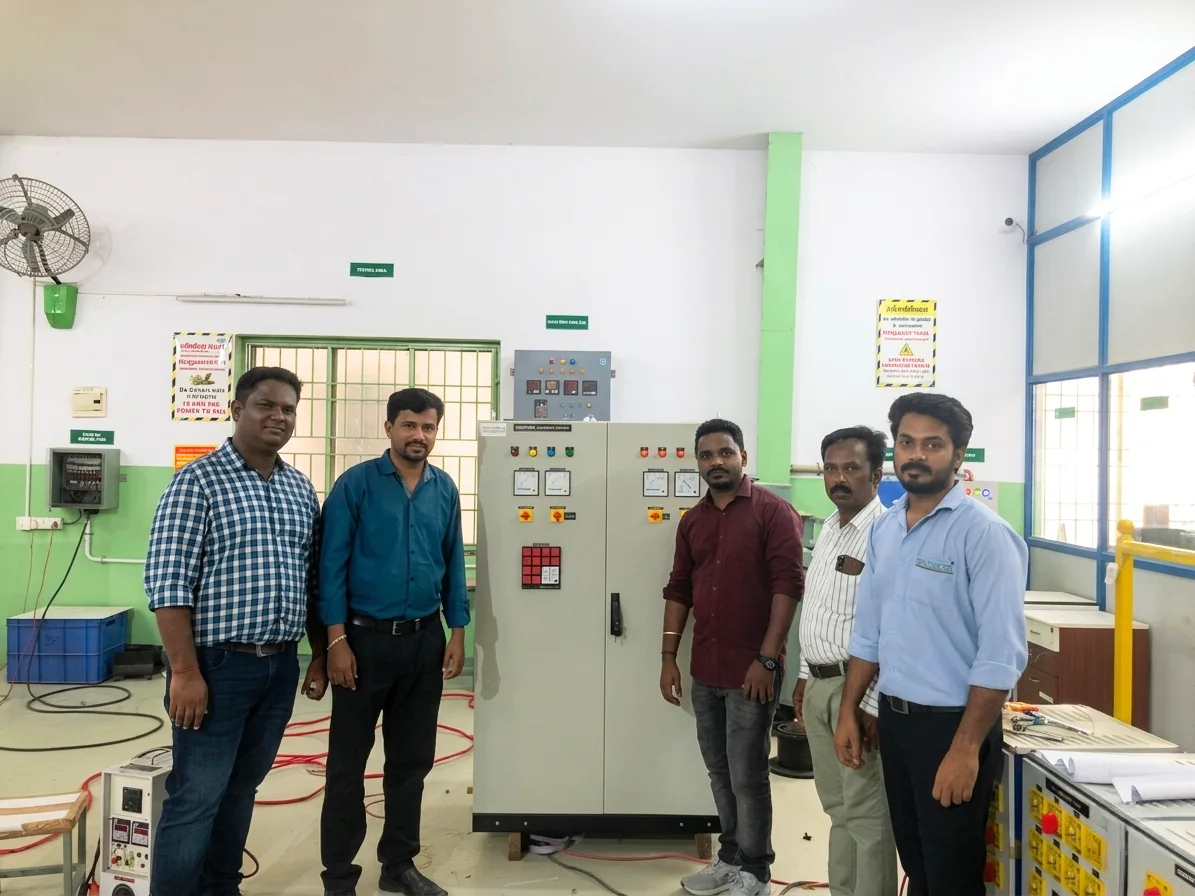
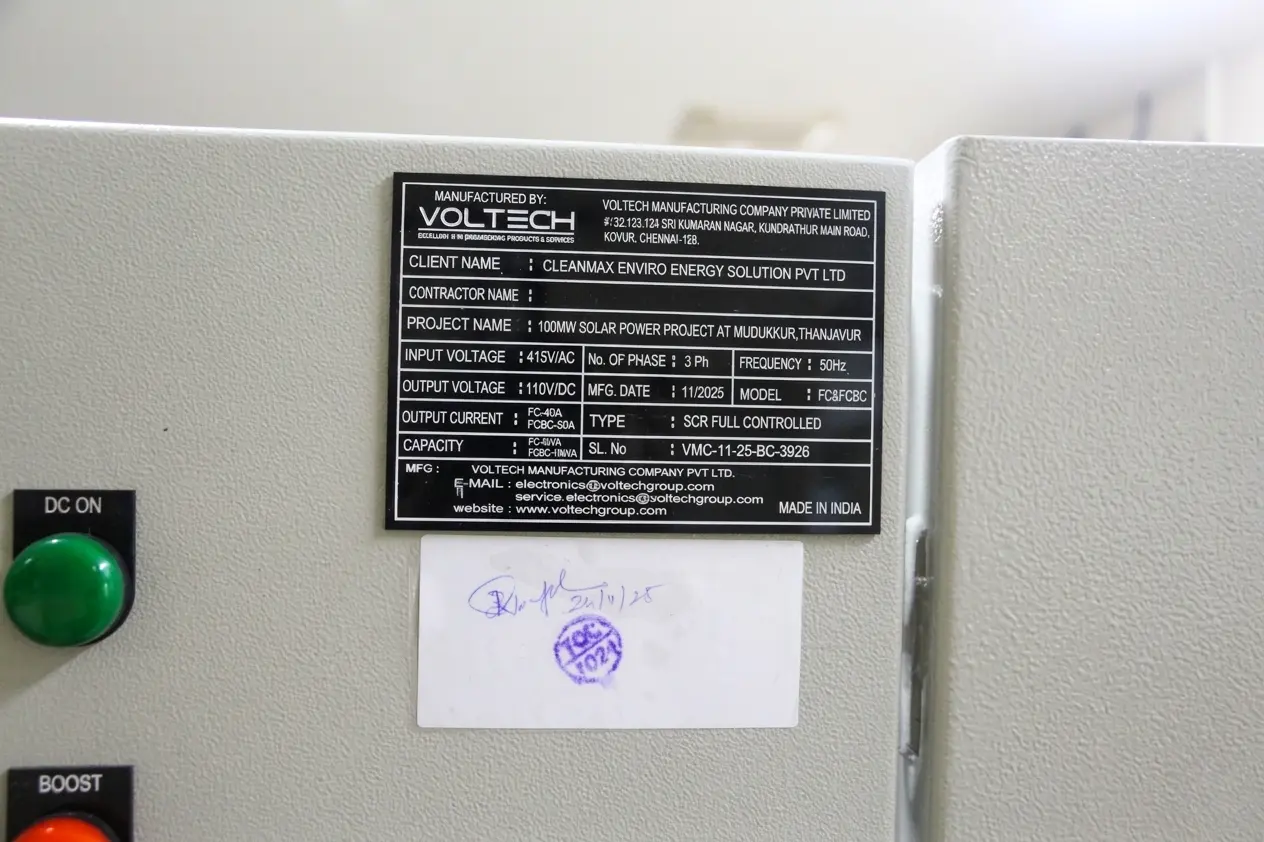
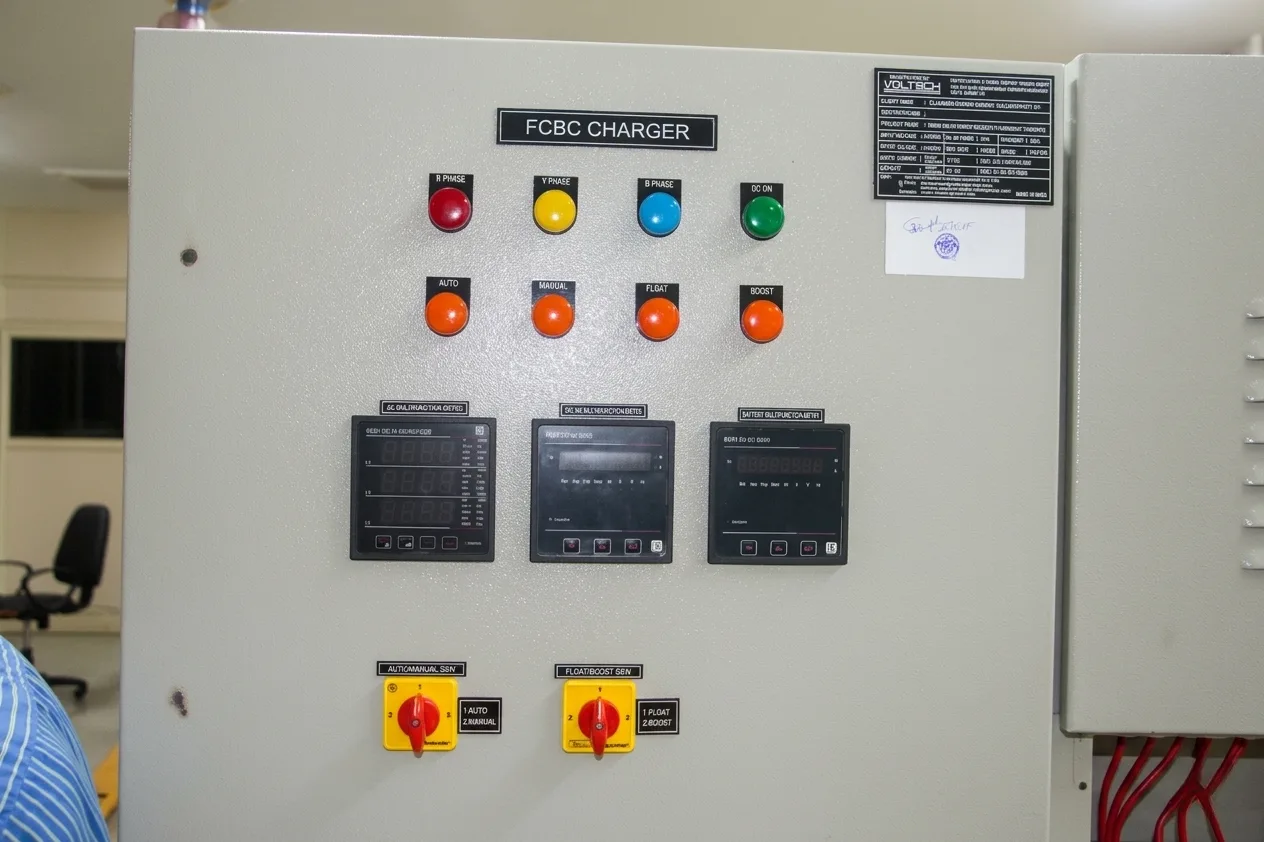
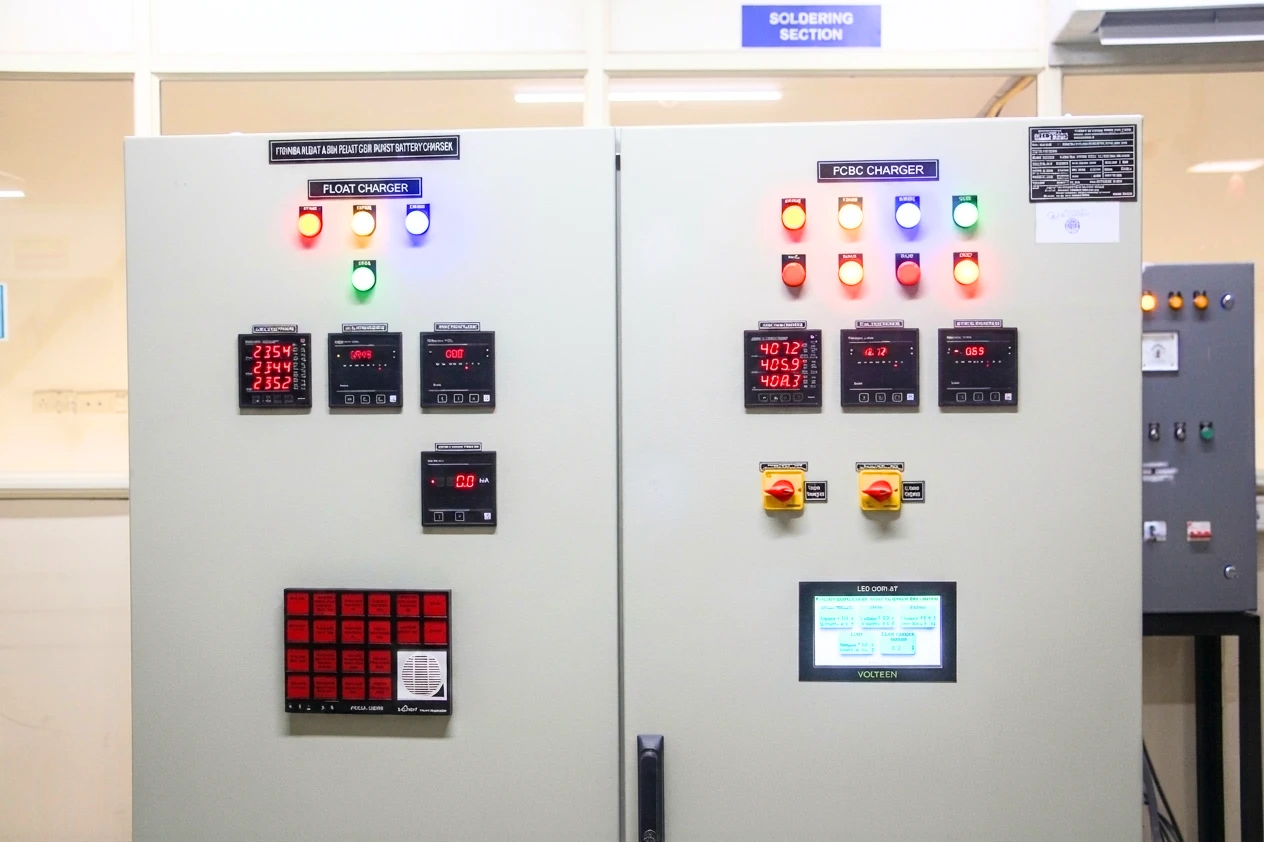
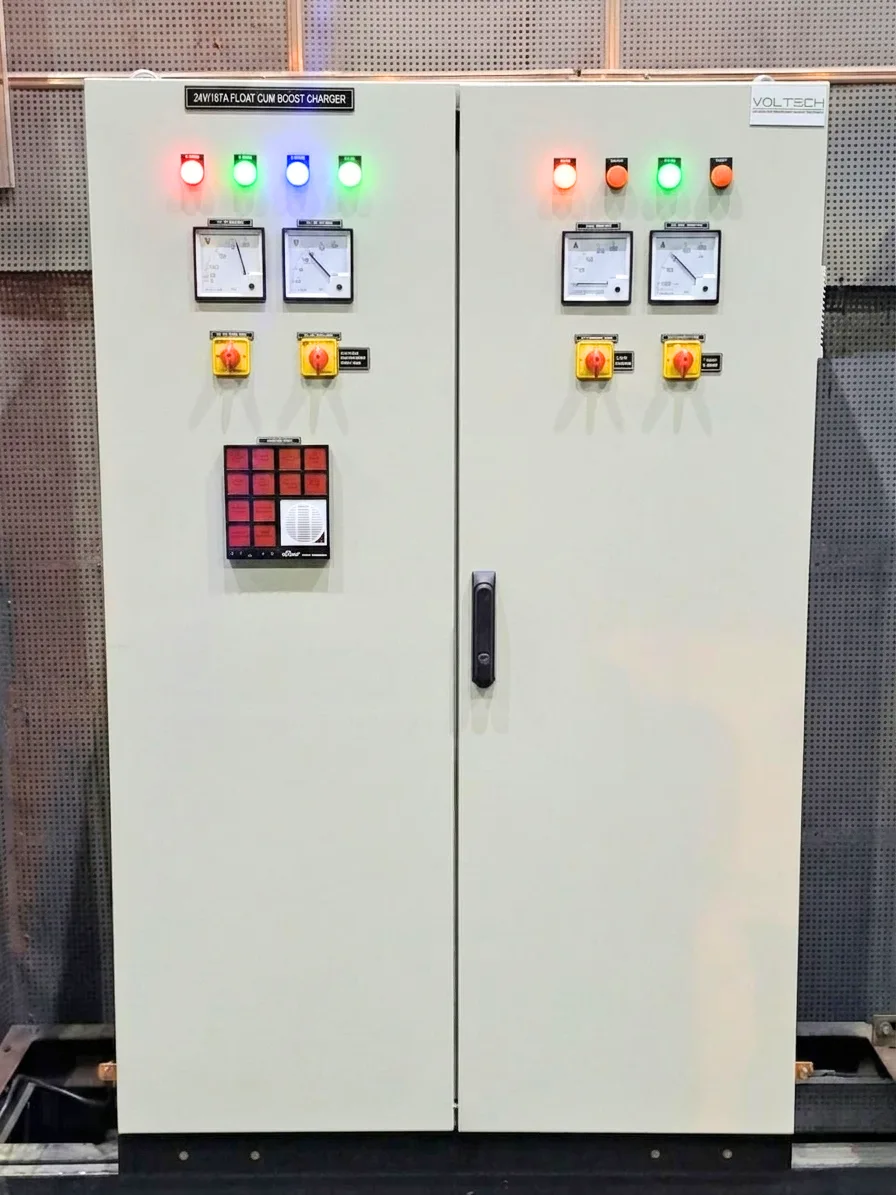
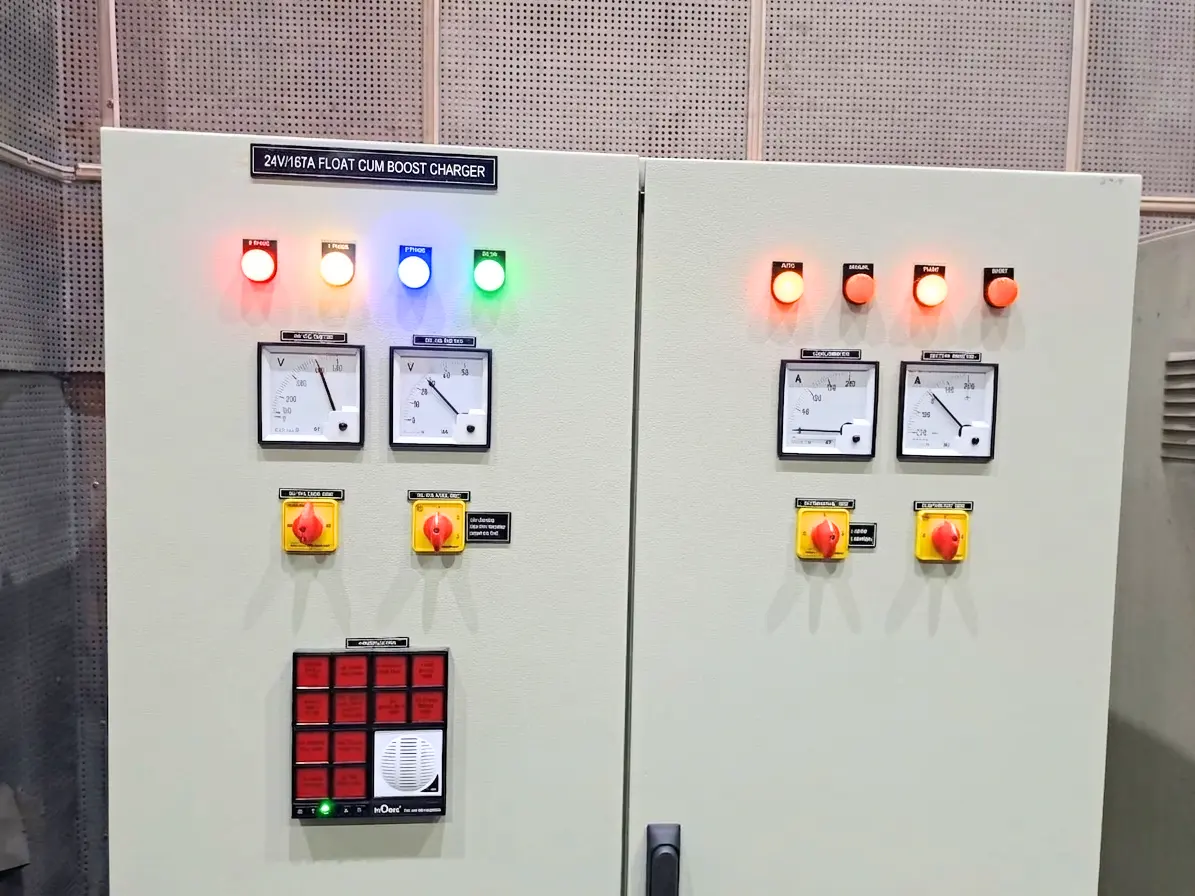
Real Voltech Float Cum Boost Charger panels, photographed at factory testing and on-site during commissioning.
CleanMax Enviro Energy Solution Pvt. Ltd.
Voltech supplied a combined Float Charger & Float Cum Boost Charger (FC & FCBC) panel for CleanMax's 100 MW solar installation at Mudukkur, Thanjavur — keeping protection relays, inverter yard controls and SCADA alive independent of grid or generation status, with auto/manual and float/boost switching, dual AC/DC/battery multifunction metering, and a full annunciation panel.
Delhi International Airport Limited (DIAL)
Voltech supplied a 24V/167A Float Cum Boost Charger to Delhi International Airport Limited (DIAL), part of the DC auxiliary backup infrastructure supporting the airport's critical power systems alongside its large diesel generator installations. The panel was witnessed at factory acceptance testing by the DIAL team before dispatch, following the same fully-controlled SCR architecture, with AC/DC voltmeters, load and battery ammeters, auto/manual and float/boost mode switches, and a full annunciation panel.

Illustrative Technical Specifications: Dual Mode FCBC Reference Design
Specification of Voltech's Dual Mode FCBC, engineered for high-demand commercial and industrial DC auxiliary systems.
| Parameter | Specification | Application Relevance |
|---|---|---|
| Output Rating | Up to 220V / 200A | Scales to full substation DC systems |
| Battery Chemistry Support | All popular chemistries | Lead Acid, VRLA, Ni-Cd, tubular |
| Rectifier Topology | Fully controlled 6-pulse SCR full-wave | Output stability at full load |
| Inrush Protection | Soft start technology | Protects battery and rectifier at start-up |
| Fault Protection | Overvoltage fold-back, short circuit, overload | Keeps load and battery safe |
| Current Limiting | Independent – battery path and charger path | Isolates battery-side from load-side faults |
| Mode Switching | Automatic/manual Float-Boost, timer precision | Fast recovery without manual intervention |
| Operator Interface | Smart HMI – real-time data, alarms, control status | Full visibility at the operator's fingertips |
| Event Logging | Up to 250 events or more | Full fault history for diagnostics |
| Grid Protection | Single-phase preventer – U/V, O/V, time delay | Disconnects before damage occurs |
| EMI/EMC | Fully compliant | Zero interference with nearby systems |
| Integration | PLC, SCADA, RS-485 MODBUS | Plugs into existing plant automation |
| Reliability | Designed for low MTBF | Built for continuous-duty environments |
Frequently Asked Questions
What does "dual mode" mean in an FCBC?
The ability to run in float mode (constant voltage, trickle-charging while feeding the load) and boost mode (higher current, fast recovery), with automatic or manual switching between the two.
Why is a 6-pulse SCR rectifier better than a standard rectifier?
It actively regulates output against AC fluctuations, holding stable DC voltage at full load — where uncontrolled rectifiers let fluctuations pass straight through to the battery and load.
Can one FCBC support multiple battery chemistries?
Yes — the Dual Mode FCBC works with all popular chemistries up to 220V and 200A, with current limiting and voltage settings adjustable to match.
What happens if the AC supply single-phases?
The built-in single-phase preventer detects the condition via under-voltage, over-voltage and time delay control, and disconnects the charger before damage occurs.
Does the charger integrate with existing SCADA systems?
Yes — it natively supports PLC, SCADA and RS-485 MODBUS, and the HMI provides local access to real-time data, alarms and control status.
How many events can the charger log?
Up to 250 events or more, giving maintenance teams a full fault and operation history without relying on external logging.

Start Your Technical Consultation
To initiate a technical consultation for your battery charger requirements, reach out to our team.
[email protected]